
Cyclone Vaianu - forecasting failure or fortunate fizzle?
Warnings and emergency advice ricocheted and amplified on social and mainstream media. Some people felt let down by what eventuated.

It’s Saturday 18 April and the good news is that Cyclone Vaianu passed on by last weekend and caused less damage than had been feared. But there’s been blowback: some say the warnings of severe weather were over-hyped and misled the public. Yes or no?
See all past posts at reidbasher.substack.com
Early warning and emergency management involve tricky communication issues
It was certainly an eye-catching headline for an opinion piece: “Huge forecasting fail: Cyclone Vaianu didn’t even kill or maim me.”
Like all satire, Hayden Donnell’s article on Tuesday 14 April in the Spinoff had a sharp point to make.
Which was that the cyclone didn’t live up to the shock-horror predictions and emergency advice promoted in the media, and that people felt misled into preparedness actions that now, in hindsight, seemed silly and unjustified.
Donnell was backed up by Wairoa’s Mayor, Craig Little, who was reported as saying we're becoming woke as a country when it comes to declaring states of emergency.
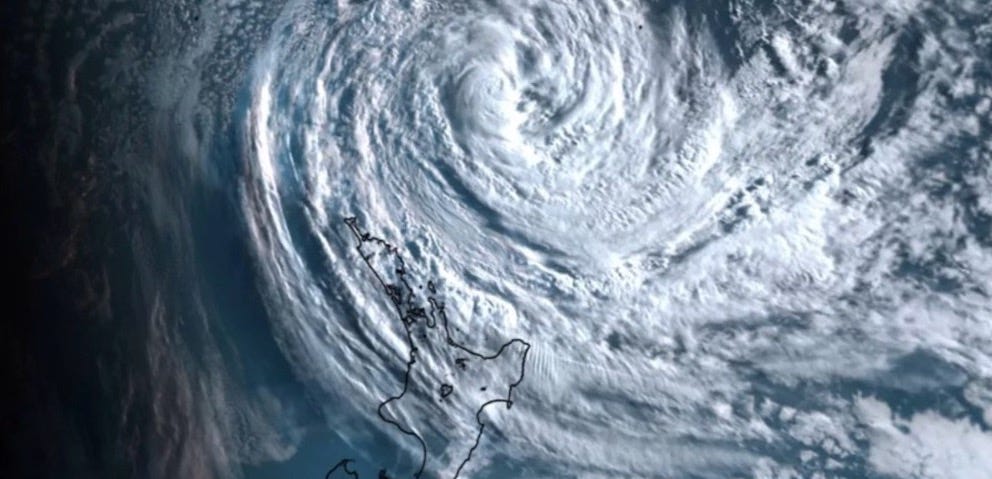
Let’s step back and unpack what happened. A week earlier, as shown in the satellite photo, Vaianu had looked big and scary, and was moving towards us with winds potentially up to 140 km/hr and torrential rainfall highly likely.
The media briefing on 8 April by John Price, head of the National Emergency Management Agency (NEMA), referred to heavy rain and extremely high winds, and provided normal, sensible preparedness advice. No shock-horror language here.
In the following days, severe weather warnings were issued by MetService for most of the northern and eastern regions of the North Island. Many regions declared regional or local states of emergency. Not Wairoa though.
In the event, the cyclone’s track luckily trended eastward as it approached, which spared us from the most extreme conditions, though some areas were still badly affected by very high winds and high rainfall that caused power outages, flooding and road closures.
However, some people, like Hayden Donnell, felt short-changed. He argues that the emergency authorities shouldn’t go the whole hog on scary warnings until they’re absolutely certain of the storm’s final path.
That’s a superficially attractive but fatally wrong strategy. It would be like putting your foot on the brakes only when you are sure the other car is really going to hit you.
When things are threatening, the right approach is to pay attention and progressively prepare as firmer information becomes available on what’s likely to happen. That’s true for cyclones as well as for deviant drivers.
The fact is a cyclone’s path and strength are not fixed a week ahead. The track can meander, the winds may become stronger or weaker, and the rainfall may become heavier or lighter.
Communicating this natural uncertainty to the public isn’t easy. For most of us, the ifs and buts and maybes will always play second fiddle to the big key message – that something bad is looming and I’d better get prepared.
Also, remember we’re still suffering a bad hangover from the 2023 North Island floods and Cyclone Gabrielle disaster, when unprecedented rainfalls shocked the meteorologists, and flooding was far greater than expected. People were unprepared and tragically some died as a result.
In an earlier post last year on 8 November, I argued that early warning systems were well-proven as cost-effective tools for saving lives and money – so long as the warnings reach those at risk, the affected people understand the warnings, and they do the right things in response.
The flaw in the Vaianu situation was mainly in the understanding step – particularly the public not appreciating the vagaries of cyclones and weather prediction, and crucially, wrongly equating the growing media hype with certainty of impending devastating disaster.
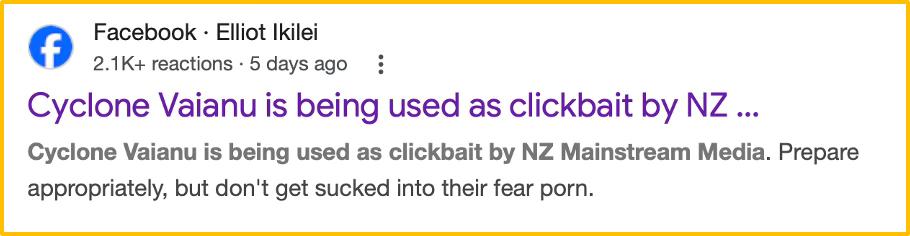
As we well know, the media and its algorithms amplify bad news and negative vibes. The fear, once established, is hard to dispel. At least one Facebook user was onto the problem:
The media plays a critical role in emergency preparedness and public safety management. But if misunderstandings emerge about the warnings, it’s primarily up to Metservice and NEMA to counteract them.
That means regular updating of warning information and proactive management of key messages throughout a storm, especially on social media and radio.
As I said in my 8 November 2025 post, no-one likes a false alarm, but it’s better to have an overshoot and be over-prepared, than to have an undershoot and suffer.
Nevertheless, I think it’s a fair criticism that many people, like Wairoa’s Mayor Little, felt pressured toward actions that seemed performative rather than sensible in terms of what they were personally seeing and hearing as the cyclone closed in. That’s something for NEMA to work on in future.
So no, it wasn’t a huge forecasting fail, it was a communication fail, and a fairly modest one at that.
Let’s not forget we got through Vaianu largely unscathed, thanks to our national warning and emergency services and all the people working for us out there during the course of the storm.
Well rounded summary, Reid. Generally we all tolerate uncertainties about general weather forecasts, even if we grumble when get caught in an unexpected 1 minute rain shower.
Yet somehow we expect the forecasts of ex-tropical cyclones and convective thunderstorms (with intense rain) to be bang on - when in fact there is a higher uncertainty associated with pinning these two weather systems down ahead of time - even just hours ahead.