
Watching and warning; how they keep us from disaster
Op-Ed in The Post, 22 April 2025, Wellington

Early warning systems have saved millions of people worldwide. But Cyclone Gabrielle showed what can go wrong.
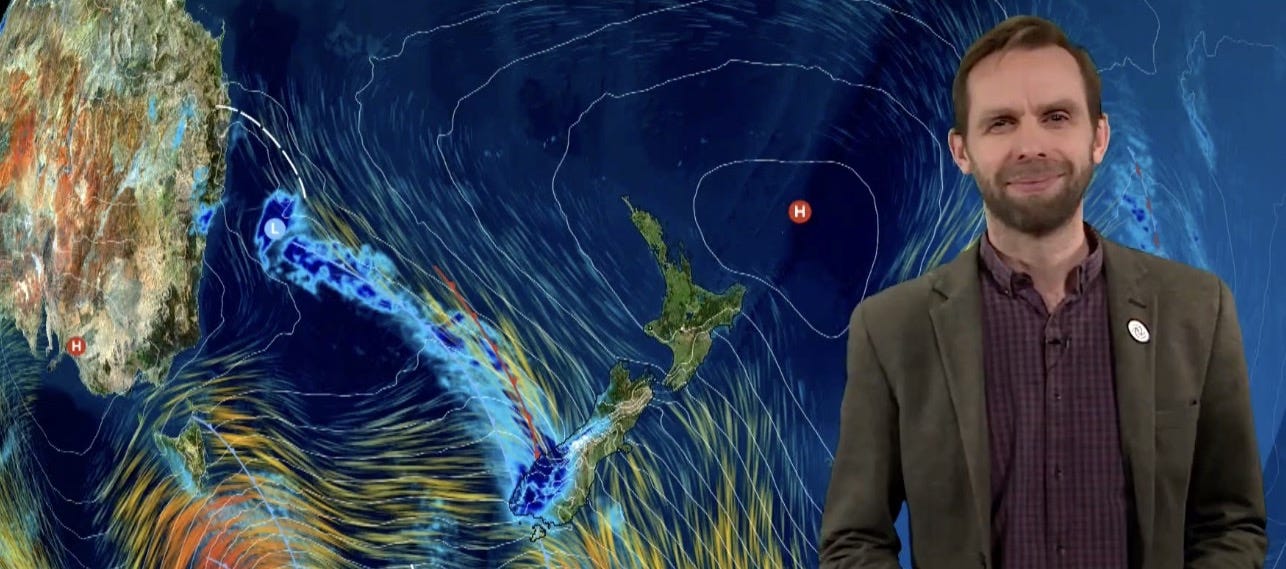
MetService’s John Law warns of heavy rain in Fiordland. High-tech prediction capability is essential, but the real test is whether the warnings reach all those at risk, these people understand the warning, and they do the right things in response.
This post is a lightly edited version of the original article. It’s the fourth of my weekly posts. Next week’s will be on disaster risk and insurance.
Here’s the Op-Ed. Read on!
Early warning systems dramatically reduce disaster impacts
In 1931, severe flooding of China’s Yangtze River reportedly left a mind-boggling 2.5 – 3.7 million people dead. A further million people died that year from the Huang He (Yellow) River floods.
Nowadays, China’s flood deaths are a tiny fraction of these figures, thanks to modern early warning systems and flood management.
Studies worldwide have shown that the benefits of well-designed early warning systems for disasters are much greater than their operational costs.
The stakes are high - recent big disasters have cost New Zealand over $100 billion altogether[1]. Some risks can be avoided, but some cannot. That’s when warning systems come into play.
Early warnings allow public authorities, businesses and individuals, to take prompt action, to evacuate people to safety, move stock, and generally batten down the hatches. This means fewer fatalities and injuries, less damage and loss, and lower costs for the economy.
But Cyclone Gabrielle, which devastated Tairāwhiti in 2023, showed what can go wrong.
The cyclone itself was not a surprise. MetService had tracked it through the tropics for days before it reached New Zealand and had issued heavy rainfall warnings. But no flood warnings or evacuation orders were issued by the responsible authorities.
So when the Esk River broke its banks, in the early hours of 14 February 2023, hundreds of shocked people were forced to escape, some by swimming through surging water that reached up to roof level. Not all would make it; altogether eleven people died in the disaster.
Although MetService issues rainfall warnings, the responsibility for flood management and flood warning lies with the regional councils, and the responsibility for leading emergency management and evacuations lies with the National Emergency Management Agency.
The Esk Valley disaster was a tough lesson for these organisations. Subsequent news reports indicated that in hindsight Hawkes Bay Regional Council had underestimated the potential for extreme flooding and had under-invested in flood management projects. [See also Postscript below.]
Shockingly, Gabrielle was almost a carbon copy of a storm in April 1938, 85 years earlier, which destroyed or damaged dozens of bridges and left a layer of silt 1 to 3 metres depth along the Esk Valley[2].
Severe damage also occurred in the region during Cyclone Giselle in April 1968 (this cyclone contributing to the sinking of the ferry Wahine), and again during Cyclone Bola in March 1988. How quickly we forget.
Experience worldwide has shown that the most effective warning systems combine four elements[3] - a 24/7 hazard warning service, knowledge of what’s at risk, multiple ways to reach all those potentially affected, and the capabilities of authorities and the public to respond after receiving a warning.
A blaring siren isn’t enough. Everyone needs to know what the alert means, what’s at risk, and what to do in response.
It’s usually one of the last three elements that causes trouble – the specific risks not being properly recognised, communications not reaching those likely to be affected, and inadequate responses by organisations and individuals.
This was the case for not only Cyclone Gabrielle but also the Whakaari / White Island eruption in December 2019, when 22 people lost their lives.
Bear in mind that warnings can never be perfect. Nature is too complex for that. No-one likes a false alarm, but it’s better to have an overshoot and be overprepared, than to have an undershoot and suffer.
In fact, overshoots are valuable as dry runs and can be counted a success if authorities and individuals responded and did the right things.
Most people know that MetService is responsible for alerts of weather hazards, including for coastal storm surge. It also advises on slower-moving weather events like drought and El Niño, and fast-moving wild fires and airborne animal disease outbreaks such as foot and mouth disease. NIWA provides similar, competing information.
Alerts for landslides, earthquakes, tsunamis and volcanic eruption are the responsibility of the National Geohazards Monitoring Centre, operated by GNS Science.
Recently, the Government decided that MetService will be acquired by NIWA, to avoid duplication and confusion of warnings, and that GNS Science and NIWA (with its MetService subsidiary) will be merged as a Public Research Organisation (PRO) for Earth Sciences, one of four new PROs to be created this year with the aim of reorienting New Zealand’s science efforts toward a greater focus on economic outcomes. [Earth Sciences NZ started operating on 1 July 2025.]
If the PRO for Earth Sciences is going to be judged on economic outcomes, there can be fewer more juicy targets than staunching the billions of dollars that bleed out of the economy in disasters.
That includes the big opportunity to better integrate weather and water science into the flood management responsibilities of the eleven regional councils, and to beef up our national warning systems.
Adding urgency to these two tasks is the fact we are facing ever-greater flooding from climate change.
When hazards threaten, we all want authoritative warning systems, not the misfires that Esk Valley residents faced. New Zealand still has some work to do to achieve this goal. China’s experience shows it’s well worth the effort.
Postscript. After publication, Hawkes Bay Regional Council contacted The Post to request a correction, saying that none of the three official inquiries after the cyclone found that it had under-invested in flood management. Nevertheless, statements by Councillors and officers after the floods, coupled with the subsequent intention of Government and Council to invest substantially more in future, clearly indicate that past investments had been insufficient. This should not be interpreted as any fault of the Council however. Other factors such as lack of technical information and inadequate central government funding are more likely constraints.
Reid Basher is a retired senior advisor in the UN International Strategy for Disaster Reduction, and led the UNISDR Platform for the Promotion of Early Warning Systems.
[1] Reid Basher, The Post, February 13, 2025, https://www.thepost.co.nz/nz-news/360564796/disasters-cost-us-billions-so-wheres-risk-management
[2] Inundated. Erick Brenstrum, National Geographic, Issue 142, Nov-Dec 2016. https://www.nzgeo.com/stories/inundated/
[3] Basics of early warning. UNISDR Platform for the Promotion of Early Warning Systems. https://www.unisdr.org/2006/ppew/whats-ew/basics-ew.htm